Biography of Basilio Testella
by Mauro Bignami

The early years
Long ago on the 2nd of June 1930 in Montegranaro, a small village on a hill where the eye is pleased with a backdrop of the sea and looks to the mountains, Basilio Testella was born. The youngest of 6 children, the son of a carpenter and a home maker. At the young age of 5 his mother passed, and his older brothers took care of him. As the only option for a career at that time, he became and “apprentice” in a family of share croppers in Montegranaro, on the land where now stands the restaurant “Villa Blanca”. In the meantime he attended elementary school, as what we now call today a “student worker” and was at that time a very common practice. Already as a boy his intelligence was clearly noticeable and something that would characterise him throughout his life. This also led him to ask the fateful question, “What will I do tomorrow?” “In the country you are always a servant and die of old age?" He then had to wait until the end of the war before returning home in '44, and devote himself to the talent that made him famous around the world, His first job was at the factory “Nuova Centauro”, also where he met his big love, Maria Guardiani, the sister of the owner whom he married on June 1, 1957. The ceremony was held in the Basilica of Loreto and was a great event at the time because cars were rare and Loreto was considered a city “far away”. From the marriage two children were born Mauro and Rossella. He stayed working in the same factory for 20 years making a fulminant career and arriving to fill the role of teacher to young apprentices. In 1964 due to health reasons he was forced to suspend work at the factory and to continue, as they say around here, “stay downstairs at home”, creating a workshop. Today it’s a museum where all the tools of his creative genius invented over the years are on show. Not only those to work shoes, but also others intended for various uses and the result of his own invention. For example and only to name a few the tool to collect snails, asparagus, mushrooms, and figs, demonstrating the breadth of interests and range of knowledge he owned. All this after receiving a modest school education in line with what the people of his generation had…
One pair of shoes every thirty hours
While the sixties and the seventies went by, while the footwear industry moved towards mechanisation and the division of labour, when the watchwords were “quantity and productivity” and factories were described by the number of pairs they made each day, in “Vasì’s workshop” shoes kept coming out the way they always had: one every thirty hours, after passing through all fifty-two stages of work under his skilled hands, without machines, with even the tools of the trade made by hand — the “lescina”, the stitch marker, the wooden last, the “cippetto”, to name a few. When people kept telling him “Vasì, this way your work won’t pay”, the master cobbler carried on as he always had, convinced that wealth lies in knowledge, in mastery of the arts and techniques, and in being able to make a pair of shoes alone, without anyone’s help, “because a true cobbler must know how to take a shoe, undo it and make it again without wasting anything”. Going against the current, with the determination of someone who can look far and see beyond the present, he went on through the years, until of all those who knew the trade of the cobbler able to make you “the shoes” only he was left (“the last one left”, as he was called and liked to call himself). Big manufacturers came to him for his “consultancy”, to use a modern word, on how to organise their production departments, for work that only he could do, or more simply “to make the samples”. The workshop in fact resembled those of the Middle Ages: the Master Cobbler surrounded by apprentices who came to learn the trade, and many people have sat at his “bench”.
A workshop that was a school
The laboratory becomes a real reference point for those who want to learn to make shoes by hand , or for those who only needed a favour, or for those who simply wanted a chat. To learn from Vasi people came from all over Italy. They came from Vigevano, Sicily, Emilia, Tuscany, Campania. He handed down the art of footwear to new generations of cobblers, though not all became cobblers. The difference with the shoemaker is that “the cobbler is able to redo and adjust a shoe, and if there is a broken piece to be able to replace it.” His motto says “you must not be selfish because selfishness ruins you” and that is why Vasì keeps open the door of his shop. To all those who want to learn the art of footwear and to all those who want to learn his work, but also for the many curious.
The Picchio d’oro
Once the president of the Moscow trade fair came all the way to watch him work. “I offered him cooked wine and told him I was expecting vodka and caviar. Eight days later they arrived.” His teaching was not only about shoemaking: he passed on the soundest ideals and values, the spirit of sacrifice and the wisdom earned through years of hard work. “Work, work in good health, and let others tell you who you are, not who you think you are.” Meanwhile his skill and experience brought a growing fame, and he became the cobbler of men of the stature of Ciampi, Cuccia and Clinton, to name only the best-known and leave out others, some of whom he could not even remember by name, being foreigners with names hard to pronounce. His fame spread beyond the trade (try going to the most famous pizzeria in Montegranaro and ask for the “pizza de Vasì”), until the Marche Region decided to give him its highest honour, the PICCHIO D’ORO, as a “figure symbolising the values and the quality of Made in Marche”.
The Picchio d’oro is the award the Region gives to a person from the Marche who has distinguished themselves in their work, in Italy and abroad. Before him it had gone to the researcher Luisa Gregori, the scientist and entrepreneur Francesco Bellini, and Iginio Straffi, the creator of the Winx. The ceremony took place on 10 December 2008 at the Teatro dell’Aquila in Fermo, during the fourth Marche Day. The prize, a sculpture by Augusto Favi, was handed to him by the president of the Region, Gian Mario Spacca, with the citation “an example and master of industriousness and ingenuity”, who passed on “his knowledge and his devotion to work to generations of footwear workers”. He was 78 and still working in his workshop.
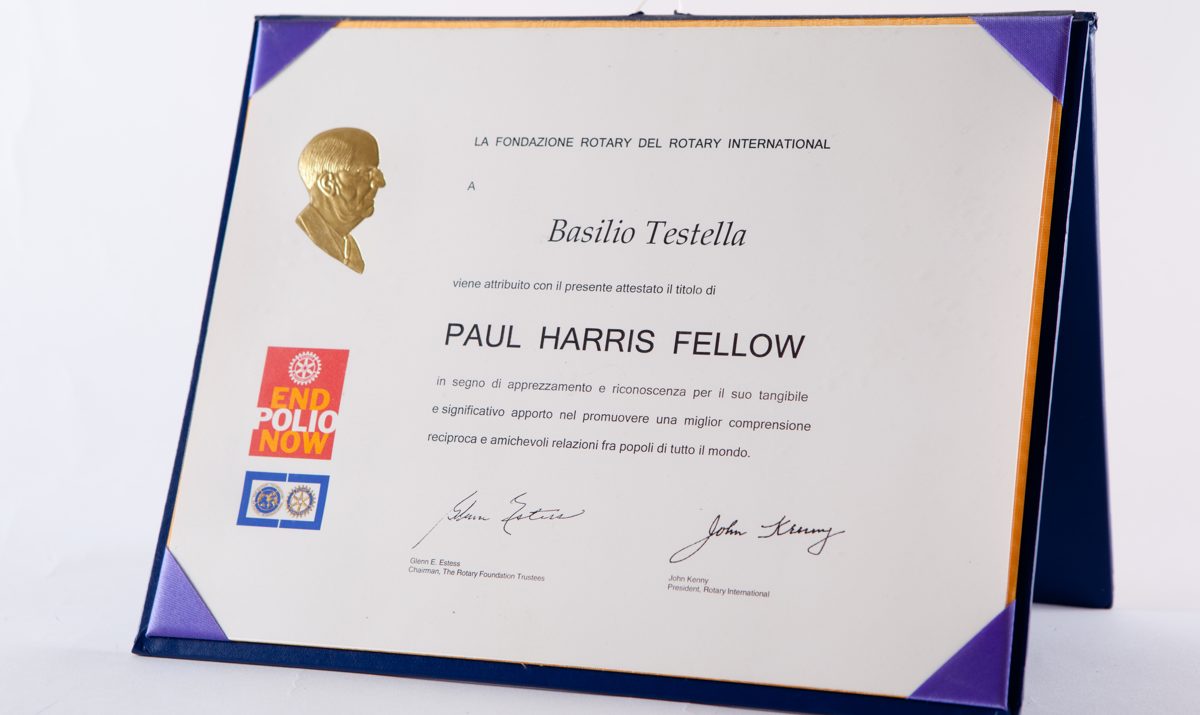
What is extraordinary is that through all this Vasì stayed himself, with the humility that only great men have, and he answered: “I only did my duty” and “I hope future generations will carry on the art I have handed down to them.” In 2010 the Rotary Club gave him its highest honour, the Paul Harris Fellow award, for having “brought the name of the Fermo area to the five continents”.
The last years
Even in this last chance he can be identified as he was in life, for his great humility and integrity: "I just did my job. I hope that young people will keep up our high traditions ": In 2009 he was struck down with an incurable disease. His determination never led him to surrender and fought with all his might. He used to say to people that he would try hard to come out as a winner. After a long struggle and with the realisation of an impossible victory he says to his beloved, “Surely they need a cobbler in heaven, I know that I have to go and I can not do anything about it.” On August 30, 2010 the candle burnt out, but he remains like a flame that still shines in the eyes of all those who knew him. In his workshop his tools are kept alive by the able hands of his children. For those who have received a gift of one of his creations or one of his inventions, now remains as a beautiful memory as a single piece by the person who built it.
Today: the MUST
Vasì’s memory lives on in Montegranaro. Since June 2024 the MUST, the Museum of History and Traditions, has an area dedicated to the cobbler’s craft and to Basilio Testella’s workshop. Read how the idea came about and how to visit.