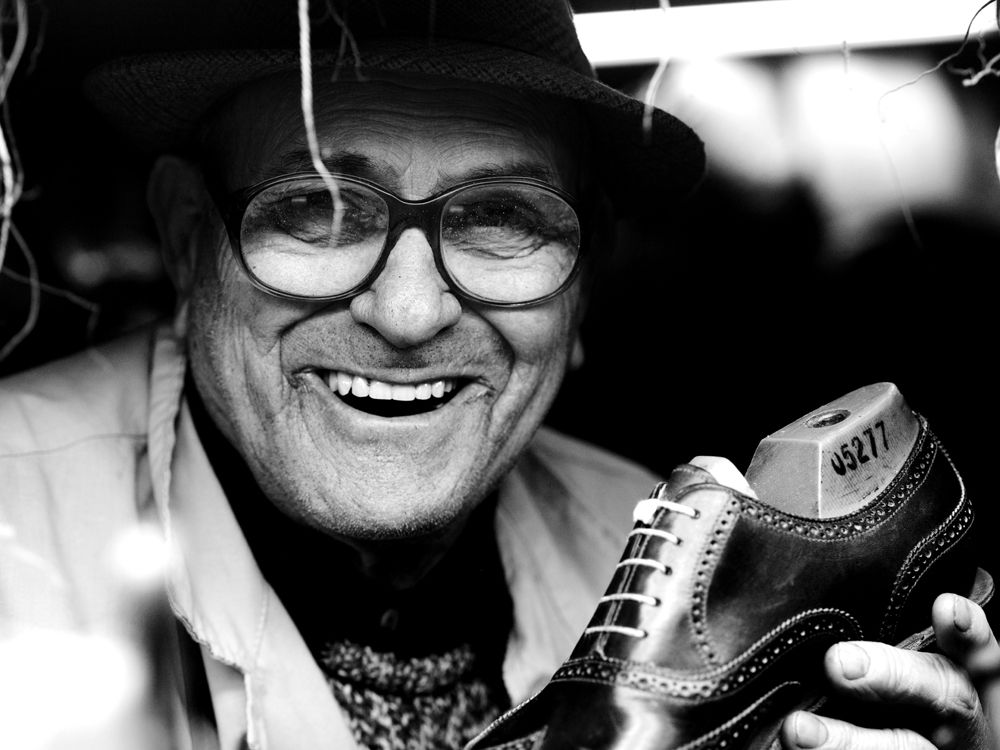
When the lightning lends you… a hand
by Mauro Bignami
An interview with Basilio Testella, the king who makes your shoes.
Photo: Patrik Gunnar Helin.
You climb along a wide road, then turn into a narrower one and climb again, then go down; you turn left, climb to the right and go down again: I should have arrived.
Unsure, I ask a man who is unloading boxes of shoes from a van where Basilio Testella’s workshop is. “Testella?” he answers, staring at me darkly and shaking his head; then he turns to his colleague and asks him the same question.
More head shaking. I feel I am lost: not in New York, Tokyo or Hong Kong, but in Montegranaro, province of Fermo, a few thousand souls and many shoe companies. Dejected, I ask the question again in a faint voice:
“Basilio Testella, cobbler, master of many entrepreneurs, teacher at the vocational shoemaking school here in Montegranaro….” Meanwhile a third man has arrived who, perhaps moved to pity by my half-desperate face, makes an effort to interpret and offers: “Of course! He’s looking for Vasì: it’s that door over there.” Such is the power of names: Basilio, Basì turned into Vasì, and you discover that you are five metres from the place you were looking for.
I knock, go in and find myself pleasantly assaulted by a mixture of smells of hide, leather, wax, rosin and rope, and as I make my way through the half-light, among the tools hanging from the ceiling and the walls, I catch sight of Mr Basilio. There he is, wrapped in a green gown like a surgeon’s, sitting on a stool in front of a low workbench, lit by a neon lamp that is also low and leaves almost everything above it in the dark. After all, why light up what is above, when Vasì finds everything above the neon simply by raising his hand and stretching out his arm in one direction or another, with gestures that recall those of a surgeon who knows he will find what he needs? Not his gaze, though: his gaze is fixed on the creature he is making, which he holds tight in the grip of his knees, which he picks up to change position, which he raises at a right angle, which he turns upside down to check with a critical eye whether the little flower made by the awl is exactly as he wants it, so that, depending on the case, he can pass the single, double or quadruple thread… that will hold the upper firmly to the sole, the sole to the welt, and so on.
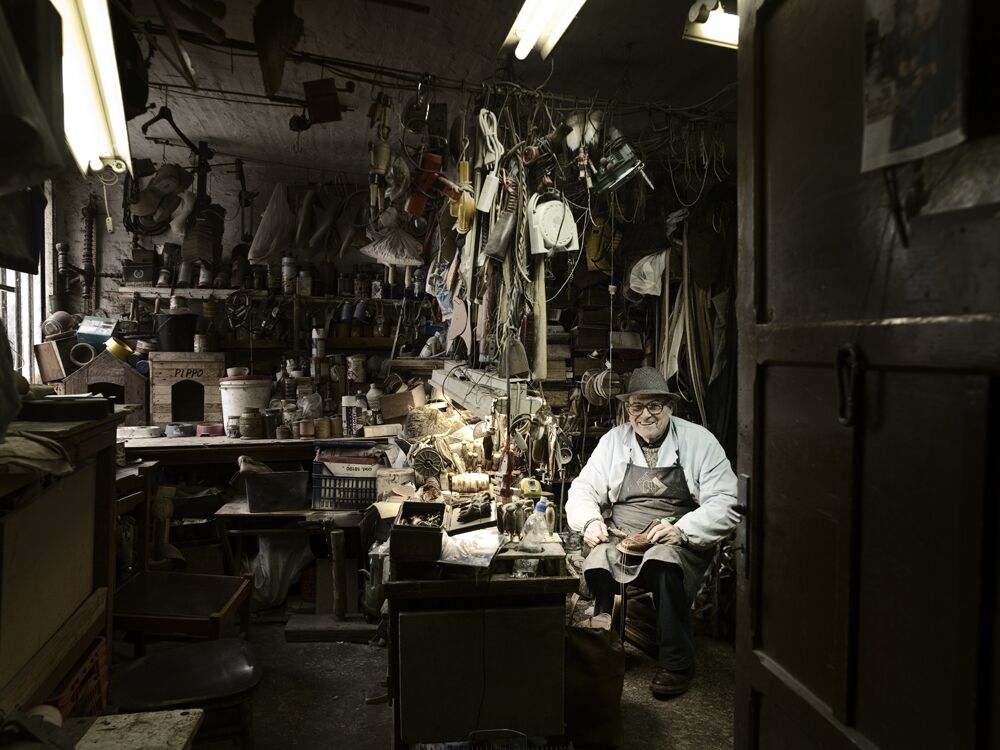
He puts everything down on the bench and finally raises his head, lit by the reflected light; he gets up, greets me with a smile and makes room for me in front of him, on a stool as low as his, so that we can talk as equals. But he always remains half-hidden by the lamp, and all I can see clearly are his hands, his fingers moving, gripping, pulling, caressing, twisting, rolling up the material and the tools of the trade. The tools are all made by himself and he is jealous of them, “because every job must have its own tool”: tool manufacturers have done very little business with him. Bed-base manufacturers have done better, because he makes the tips of his awls from the steel of bedsprings. Just one tool, again an awl, smaller than the others, he found ready-made… by nature.
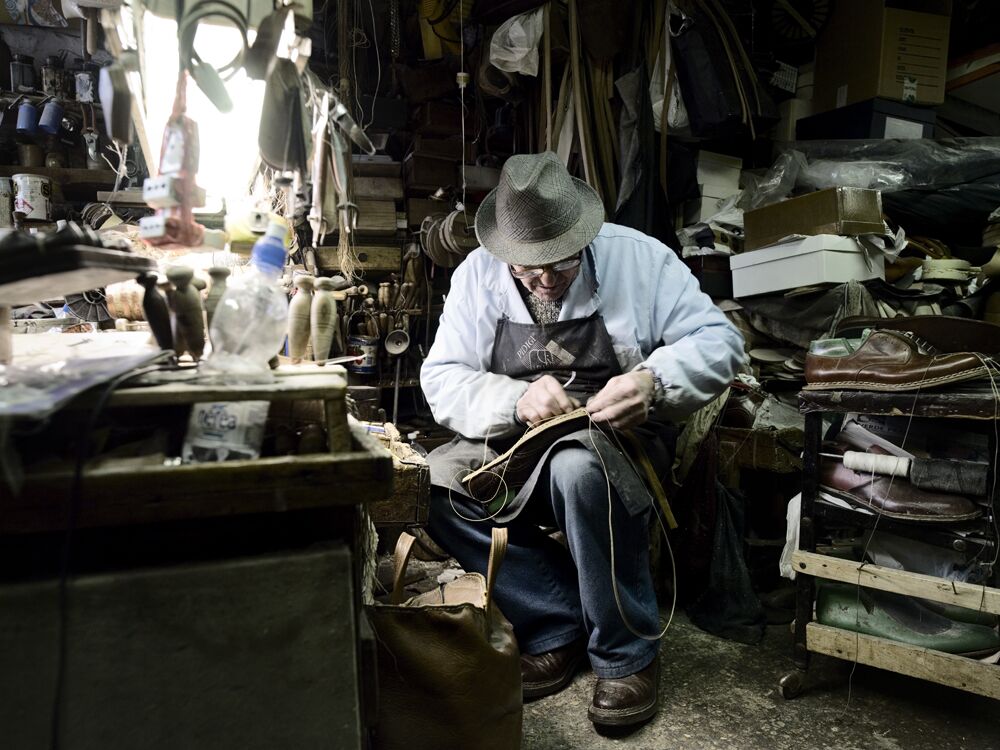
“In 1964, in the countryside, I was walking along a row of vines when I stepped on something that broke: it was the wire meant to hold up the vines which, struck by lightning, had been tempered and broken into many small pieces. Here they are: I put a handle on it and that was that.”
When did you start working as a shoemaker?
“Cobbler, not shoemaker, and I will explain why later,” he replies, upsetting my ideas about the difference between the two words. “I started when I was eight, in ’38; I was a farmhand in the countryside, and my father was a carpenter who built barrels, vats, rakes, carts and also the ‘carri matti’, which, since there were no cranes, were used to carry large tree trunks slung underneath,” he adds, noticing my blank look about these means of transport. “One day,” Testella goes on, “I said to myself: in the countryside you die of old age and you are still a farmhand. So in 1944 I went to work in the factory of a distant relative, Alberto Guardiani, where they put me to stitching the watertight seams of boots.”
Just like that, without ever having held a needle and thread?
“But do you know anything about the countryside in those days? I not only worked wood, repaired and built tools, but I was already sewing shoes at home, to mend them.” With golden hands like those, with his intelligence and plenty of grit, Mr Basilio learns to do everything in a shoe, from cutting to finishing, even the laces: oh yes, “because a real cobbler must be able to take a shoe, take it apart and make it again, turning the leather if need be, without spoiling anything,” he remarks. Testella is so good that at a certain point Guardiani puts him in charge of teaching the young apprentices who join the company. In 1964, for health reasons, he sets up on his own; he makes his own shoes and his own tools (which he also makes for a few cobbler friends), starts teaching on the supplementary courses of the Montegranaro vocational school and, with the reputation he has earned, opens a workshop the way Maggiolini did in his day: the great names of yesterday and today went to him to learn the trade, Campanile, Santoni, Lattanzi, Speranzoni, Artioli… At Lattanzi he also organised the handmade production departments, and then prepared the samples for Church’s after the company was taken over by Prada. Today young and not-so-young people go to him to learn the trade, among them a musician from Castiglione del Lago and a lawyer from Macerata. “It’s not that they chose the wrong calling: they love shoes and are curious to see how they are made, they want to enjoy the pleasure of using their hands, even if in the first days they hurt themselves with tools so different from a pen and a trumpet.”
Will they become your competitors?
Even though he is not looking at me, I know he is smiling: “I’m pleased to have taught.”
In the meantime he has made shoes for Ciampi, for Cuccia, for Fede and for many others whose names he cannot remember, because they are Russian, Japanese, Chinese, American… “How could I?” Someone nearby suggests Clinton, the Prince of Jordan, a cousin of Prince Charles, Putin, but he shrugs, to say that the subject is closed.
Do you ever work with a machine?
“Do you see a machine here?” he bursts out. In fact there isn’t one. “I know machines and I know how to use them, because to teach you have to know how to do things, and I use them well because I can do the same work by hand. Today, instead, people who work with a machine are lost without it, because they cannot use their hands; so often they don’t make shoes, they make holes for the feet!” I get the idea of holes for the feet, but he presses on: “Do you know what holes for the feet are? They are like the holes in the countryside where tree trunks were dropped to mark them, first on one side, then on the other in another hole, and so on. A temporary store, not a home. Well, shoes must live with the foot and for the foot, they must follow the irregularities of the foot, because the right and the left are different, so they have to be made in a certain way, with good materials, sound leathers and a lot of passion. And your tarsus, what is it like?” I don’t know, I confess, alas. And so it comes out that making a shoe takes 52 operations (first comes the work of the cutter and of the laster), for more than 30 hours of work: once a single person did everything; today there are 52 firms, each doing a single operation, which has meant “throwing quality away”.
And then there are the hide and the leather, which are essential to make sure the foot is not forced into unnatural positions. Speaking of leathers, there are calf, crocodile, deer and so on, but the most precious leather in the world “is the horse butt, the skin on the inside of the hind legs, running from the groin to the stifle” (to tell the truth, his words are far more colourful).
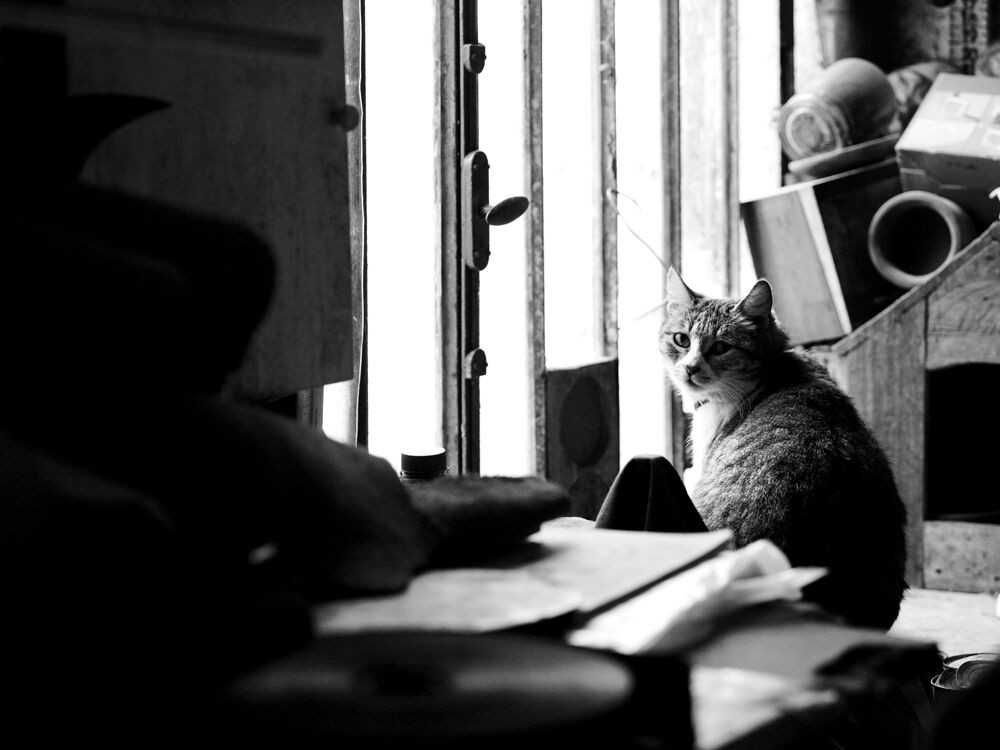
As we talk, a little grey cat, complete with collar and bell, roams like the mistress of the place over the tools and under the bench, climbing up and down everywhere as if on a routine inspection, until she stops to sniff my shoes; she looks at me with one ear down and one up, one eye half closed, showing a certain disappointment, as if let down. “Look at your shoes,” Testella orders, “the leather is not the best, and then they are badly looked after.”
Et voilà: in a double, simultaneous blow, a cat and Basilio Vasì of Montegranaro have destroyed my certainties about English shoes and about my method of caring for them, learned from none other than Lord Brummell.
“Give them here!” orders King Basilio. I take off my shoes with some hesitation; he takes them, looks at them closely and shakes his head. “You need virgin beeswax,” he insists, and with a block of wax that looks like Marseille soap he rubs the toe and the heel of my shoe, whose brand I will not write out of modesty. “Then an old flannel shirt, and finally elbow grease!” He starts going back and forth over my holes for the feet, which within a few seconds look as they did when new. Today’s polishes ruin the leather, they dry it out, whereas wax nourishes it. Or you can use half a kiwi (yes, the New Zealand fruit), spread with a cloth. To make them waterproof, on the other hand, you need horse lard: “Do you know what lard is?” “Of course I do,” I reply, and add: “pork, horse…” “Pork, before it is salted, otherwise it stinks,” he stresses, and adds, suddenly switching to the familiar ‘tu’: “What, are you a farmer, that you know what lard is?” Poet or farmer, who knows. Perhaps more the latter than the former.
How much does a pair of shoes made by you cost?
“I don’t know, but one thing is certain: shoes you pay a lot for last longer, also because you treat them better, you take care not to walk through puddles, you always clean them and so on.”
You still work today: when do you think you will stop?
“I enjoy working and teaching too, and then, as long as people come asking for me, as long as I am surrounded by friends, why should I stop? The days are long, there is time to die, and when I am dead they will make a museum of my workshop.”
Is it harder to teach today or in the past?
“In my day people wanted to learn because it was a way to get on; the saying was ‘learn a trade and put it aside’. Today it is harder to teach because the world is different; young people say ‘it’s too much effort, I’m not interested’, and then they want the money straight away. Everything has changed: the passion for learning and handing down is gone.”
When you were young, did you think you would become a Master?
“Yes, because ever since I was a farmhand I noticed that I made the best tools, so I thought I could become somebody.”